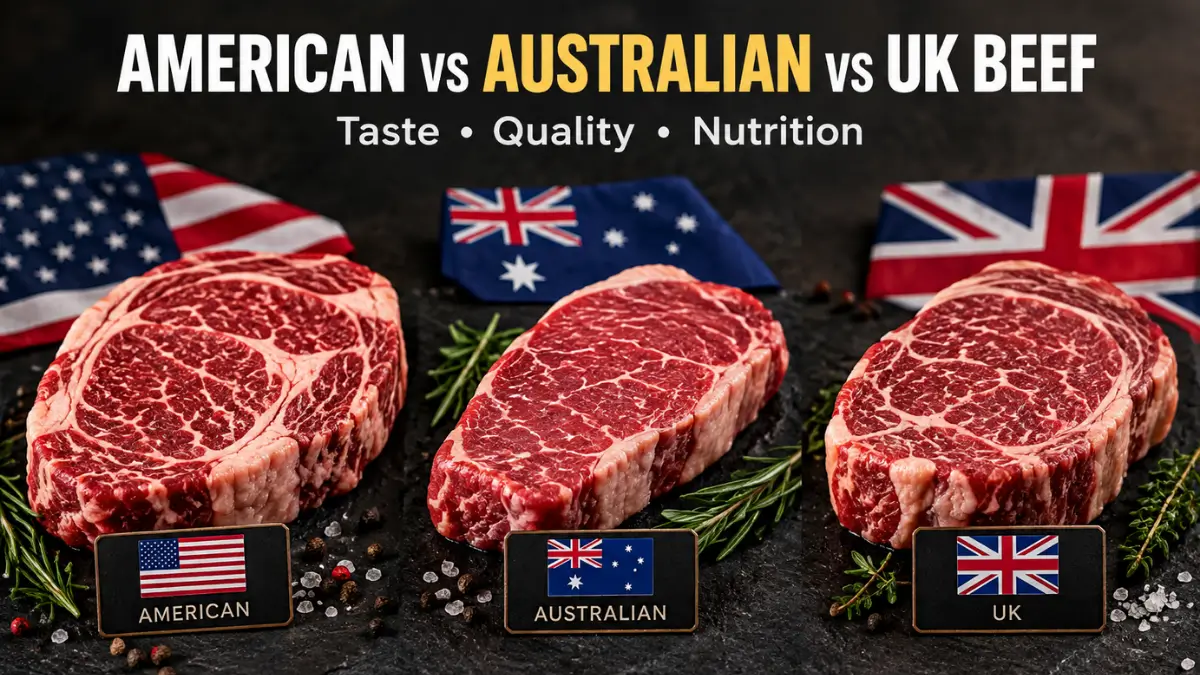
American beef vs Australian beef vs UK beef: the best choice depends less on nationality alone and more on breed, cattle diet, marbling, ageing, cut, and cooking method. American beef is often associated with rich marbling and a buttery texture, Australian beef offers a broad range from lean grass-fed meat to highly marbled grain-fed beef, while UK beef is commonly valued for its traditional flavour, traceability, and pasture-based production.
All three countries produce excellent beef. However, their farming systems, grading practices, climate, breeds, and consumer preferences create noticeable differences in flavour, tenderness, appearance, and nutritional profile.
American, Australian and UK Beef at a Glance
| Feature | American beef | Australian beef | UK beef |
| Common production style | Grain-finished, with grass-fed and organic options | Grass-fed, grain-finished and mixed systems | Mainly pasture-based, with some indoor finishing |
| Typical flavour | Mild, rich and buttery | Ranges from clean and grassy to rich and beefy | Distinctive, savoury and traditionally beefy |
| Marbling | Often high, especially in USDA Prime and Choice | Highly variable; premium grain-fed beef can be heavily marbled | Usually moderate, though quality varies by breed and feeding |
| Texture | Frequently soft and succulent | Can be firm and lean or tender and richly marbled | Often firm with a pronounced beef flavour |
| Nutrition tendency | More variable fat content; highly marbled cuts are calorie-dense | Grass-fed options are often leaner | Often lean to moderately fatty, depending on cut and system |
| Popular cuts | Rib-eye, strip steak, tenderloin, brisket | Wagyu, Angus, rump, sirloin and grass-fed steaks | Sirloin, rump, topside, fillet and roasting joints |
| Best known for | Marbling and steakhouse-style tenderness | Production diversity and premium beef programmes | Provenance, pasture systems and traditional flavour |
These are broad patterns rather than fixed rules. A lean American grass-fed steak may differ more from American grain-fed beef than Australian grain-fed beef does. Similarly, British beef from a well-marbled Angus animal may be richer and more tender than a very lean grass-fed steak from another country.
Taste and Flavour Differences
American beef flavour
American beef is widely recognised for its rich, mild flavour, particularly when it comes from grain-finished cattle. Grain finishing generally increases intramuscular fat, also known as marbling. During cooking, this fat melts through the muscle and creates a juicy, buttery eating experience.
A well-marbled American rib-eye may taste creamy and slightly sweet, with a soft texture. The flavour is usually less earthy than that of strongly grass-fed beef. This makes it popular in steakhouses, burgers, barbecue and recipes where tenderness and richness are central to the dish.
American beef is not always grain-fed, however. Grass-fed American beef can have a more pronounced, mineral-like or grassy flavour and may be leaner. The label, feeding claim and grade should therefore be checked instead of assuming that all American beef has the same taste.
Australian beef flavour
Australian beef has one of the widest flavour ranges because the country uses several production systems. Much Australian cattle spend a significant part of their lives grazing pasture. Grass-fed Australian beef is commonly leaner, with a firmer bite and a more noticeable savoury or grassy flavour.
Some consumers describe premium grass-fed beef as clean, fresh and distinctly beefy. Others may find it stronger than grain-finished beef. The difference is especially apparent when comparing a lean grass-fed sirloin with a heavily marbled steak.
Australian grain-fed beef can be very different. Cattle may be finished on a higher-energy diet to improve marbling and tenderness. Premium Australian Wagyu and Angus products can provide a rich, buttery texture that competes with high-grade American beef. Australian beef should therefore be viewed as a diverse category rather than one uniform style.
UK beef flavour
UK beef is often associated with pasture-based farming and traditional beef flavour. Cattle raised on grass and forage can develop a deep, savoury taste, particularly when the meat is properly matured. The flavour may be more pronounced than in mild grain-finished American beef, while the texture can be pleasantly firm rather than exceptionally soft.
British beef is available from many breeds, including Aberdeen Angus, Hereford, Limousin, Shorthorn and native breeds. Breed, age, fat cover, feeding system and maturation all influence the final result.
Dry ageing and wet ageing can also change the eating experience. Proper maturation allows natural enzymes to improve tenderness and intensify flavour. A well-aged British sirloin can be robust and complex, whereas a lightly matured cut may taste milder and have a firmer texture.
Tenderness and Marbling Compared
Marbling is one of the most important factors affecting tenderness, juiciness and flavour. It refers to small deposits of fat within the muscle, not the external fat around the steak.
American beef is especially known for formal quality grades that reward marbling. USDA Prime generally contains more marbling than USDA Choice, while Select is leaner. A highly marbled American steak is likely to be tender when cooked correctly, although the grade does not guarantee that every cut will have the same texture.
Australia uses its own grading and eating-quality systems, including the Meat Standards Australia approach. Australian beef may be sold according to brand, breed, marbling score, ageing period and production system. Premium Australian Wagyu can be extremely marbled, while ordinary grass-fed beef may be much leaner.
The UK does not have one single grading system that consumers use in exactly the same way as the American USDA scale. British beef is assessed through factors such as conformation, fat class, breed, age and production standards. Retailers and producers may also provide information about maturation, provenance and breed.
In practical terms, a buyer should examine the steak itself. Look for even marbling, a bright cherry-red colour, a firm surface and appropriate fat cover. Excessively dark, dry or soft-looking meat may indicate poor handling, although vacuum-packed beef can appear darker before exposure to air.
Quality Standards and Traceability
Quality is broader than tenderness. It includes food safety, animal health, processing hygiene, traceability, consistency and the suitability of the meat for its intended use.
American beef benefits from a well-established inspection and grading system. USDA inspection focuses on food safety, while USDA quality grades help communicate expected eating quality. Prime, Choice and Select are familiar examples, although branded programmes and grass-fed claims add further distinctions.
Australian beef is exported widely and is supported by detailed identification and traceability systems. The country also has established programmes for grass-fed, grain-fed, organic, Angus and Wagyu beef. These labels can be useful, but consumers should understand that they describe different attributes. “Grass-fed” relates to diet, “organic” relates to certified production standards, and “Wagyu” relates to breed background rather than automatically guaranteeing a specific marbling level.
UK beef is often valued for farm-to-fork traceability and clear provenance. British retailers may identify the farm, county, breed or assurance scheme associated with the product. Red Tractor and other assurance programmes can indicate that defined standards have been followed, although the exact criteria depend on the scheme and product.
No country automatically produces better beef in every category. A premium product from any of the three countries can outperform a lower-grade product from the others.
Nutrition: Which Beef Is Healthier?
The nutritional value of beef depends mainly on the cut, visible fat, portion size and cooking method. Country of origin alone does not determine whether beef is healthy.
A lean steak from any country can provide high-quality protein, iron, zinc, vitamin B12 and other B vitamins. Protein supports muscle maintenance, while iron and vitamin B12 are important for normal blood and nervous-system function.
Highly marbled beef contains more fat and therefore more calories per serving. The amount of saturated fat also tends to rise as total fat increases. This does not make marbled beef unsuitable for everyone, but it means portion size and frequency matter, especially for people managing energy intake or blood cholesterol.
Grass-fed beef is often leaner than heavily grain-finished beef, but this is not guaranteed. A grass-fed rib-eye can still contain considerable fat, while a grain-finished rump steak may be comparatively lean. The cut and visible fat are more useful indicators than the country name.
Some research suggests that grass-fed beef may contain somewhat different fatty-acid proportions, including potentially higher amounts of omega-3 fatty acids, compared with intensively grain-finished beef. However, the overall nutritional difference in a normal portion is usually less important than choosing a lean cut, controlling portion size and maintaining a balanced diet.
Approximate nutrition by cut
| Beef characteristic | Likely nutritional effect |
| Lean topside, round or trimmed sirloin | Lower fat and calorie content |
| Rib-eye with visible marbling | Higher fat, calories and saturated fat |
| Minced beef with high fat percentage | More calorie-dense than lean mince |
| Grass-fed lean steak | Often lower in total fat, but not always |
| Premium Wagyu or highly marbled beef | Much higher fat and energy density |
| Grilled or roasted beef | Usually lower in added fat than fried beef |
| Processed beef products | May contain more sodium and additives |
Cooking method also matters. Grilling, roasting or pan-searing without excessive added fat can preserve flavour while keeping the meal relatively simple. Avoid charring meat heavily, and do not rely on processed beef products as a daily staple.
Best Beef for Different Dishes
American beef is an excellent choice for thick steaks, burgers, barbecue brisket and dishes that benefit from rich marbling. USDA Prime or well-marbled Choice beef works particularly well when the goal is a tender, juicy steak with a mild flavour.
Australian beef is highly versatile. Lean grass-fed cuts are suitable for everyday meals, stir-fries, salads and quick grilling. Grain-fed Angus is a strong option for steaks, while Australian Wagyu is best reserved for smaller portions because its richness can be intense.
UK beef is especially good for Sunday roasts, traditional pies, stews and steaks where a deeper beef flavour is desirable. Rump and topside can work well for roasting, while shin, chuck and brisket become tender through slow cooking.
The cut should match the cooking method. Tender cuts such as fillet and sirloin need little cooking time, whereas collagen-rich cuts such as brisket, chuck and shin usually require low, slow cooking. Overcooking a lean steak can make it dry regardless of where it was produced.
American vs Australian vs UK Beef: Which Should You Choose?
Choose American beef if you prefer a mild flavour, abundant marbling and a soft, steakhouse-style texture. It is particularly appealing for rib-eye, strip steak and burgers.
Choose Australian beef if you want the greatest range of production styles. Grass-fed beef offers a leaner, more pronounced flavour, while grain-fed Angus and Wagyu provide greater richness and tenderness.
Choose UK beef if you value pasture-based production, traceability and a traditional, savoury beef flavour. It is especially suitable for roasts and hearty British-style cooking.
For nutrition, select the leanest cut that still suits your recipe, trim visible fat where appropriate and keep portions moderate. For flavour, look at marbling, maturation and cooking method rather than relying only on the country of origin.
Frequently Asked Questions
Is American beef better than Australian beef?
Neither is universally better. American beef is often richer and more heavily marbled, while Australian beef offers both lean grass-fed and highly marbled grain-fed options.
Is UK beef healthier than American beef?
Not automatically. Healthiness depends mainly on the cut, fat content, portion size and cooking method. Lean UK beef and lean American beef can have similar nutritional advantages.
Which beef has the strongest flavour?
Grass-fed Australian and pasture-based UK beef often have a more pronounced savoury or grassy flavour. Grain-finished American beef is usually milder and richer.
Which beef is most tender?
Highly marbled beef is generally the most tender, whether it comes from the United States, Australia or the UK. Cut selection, ageing and cooking are equally important.
Is grass-fed beef always lower in fat?
No. Grass-fed beef is often leaner, but fat levels vary by breed, cut, age and finishing system. Check the visible marbling and nutrition information when available.