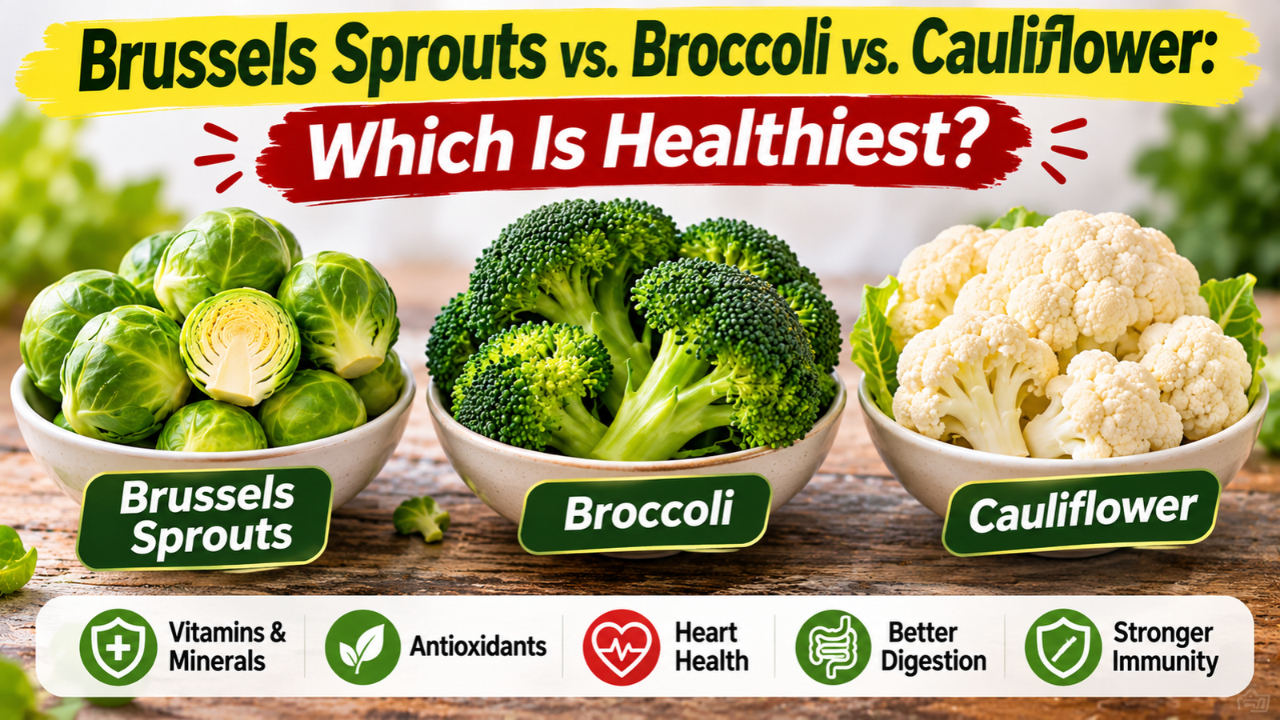
Brussels sprouts, broccoli, and cauliflower are three popular cruciferous vegetables from the same plant family. All three are low in calories, rich in fiber, and packed with vitamins and plant compounds that support overall health.
Many people ask which one is the “healthiest.” The simple answer is that Brussels sprouts are the most nutrient-dense per 100 grams, while broccoli is the best all-round choice and cauliflower is the lightest and most versatile. But the best vegetable is the one you enjoy eating regularly.
These vegetables contain special compounds called glucosinolates. When vegetables are chopped or chewed, these compounds can form substances such as sulforaphane and isothiocyanates, which are studied for their possible protective effects against cell damage.
Why These Vegetables Matter
Cruciferous vegetables are important because they provide vitamin C, vitamin K, folate, minerals, fiber, and antioxidants. They also contain very little fat and no cholesterol.
Eating different vegetables is better than depending on only one. Each vegetable has a different nutrition profile, taste, texture, and cooking method.
Brussels Sprouts vs. Broccoli vs. Cauliflower
The table below compares the three vegetables per 100 grams of raw vegetable. This makes the comparison fair because serving sizes can differ.

| Nutrient per 100 g, raw | Brussels sprouts | Broccoli | Cauliflower |
| Calories | 43 kcal | About 34 kcal | About 23 kcal item+2 |
| Protein | 3.4 g | About 2.8 g | About 1.6 g item+2 |
| Carbohydrates | 8.9 g | About 6.6 g | About 4.7 g item+2 |
| Fiber | 3.8 g | About 2.4 g | About 1.9 g item+2 |
| Vitamin C | 85 mg | About 89–91 mg | About 67 mg item+2 |
| Vitamin K | 177 mcg | About 102 mcg | About 16 mcg |
| Folate | About 61 mcg | About 63 mcg | About 57 mcg |
| Potassium | 389 mg | About 316 mg | About 274 mg item+2 |
| Best strength | Highest fiber and vitamin K | Best overall balance | Lowest calories, mild taste |
Brussels Sprouts: The Fiber and Vitamin K Winner
Brussels sprouts are small, green, and slightly bitter. They are the strongest choice if you want more dietary fiber, vitamin K, and protein in a small serving.
One cup of raw Brussels sprouts gives about 156 mcg of vitamin K, which is more than the adult Daily Value of 120 mcg. Vitamin K supports normal blood clotting and bone health.
- They provide 3.8 g fiber per 100 g, more than broccoli or cauliflower.
- Fiber helps digestion, keeps you full for longer, and supports healthy bowel movement.
- They are higher in calories than cauliflower, but still low in calories overall.item
- Roasting Brussels sprouts with a small amount of olive oil can reduce bitterness and improve taste.
Broccoli: The Best All-Round Vegetable
Broccoli is often considered the best overall choice because it offers a strong mix of vitamin C, vitamin K, fiber, folate, and antioxidants. It is not the highest in every nutrient, but it performs well across almost all categories.
A cup of chopped raw broccoli has about 31 calories, 2 g fiber, and 90 mg vitamin C. Vitamin C supports immunity, skin health, and iron absorption from plant foods.
- Broccoli contains sulforaphane, a plant compound linked in research to possible protective effects against cell damage.
- It has much more vitamin K than cauliflower.
- It is easy to add to salads, soups, stir-fries, pasta, and rice dishes.
- Light steaming is a good way to cook broccoli without losing too many nutrients.
Cauliflower: The Lightest and Most Versatile
Cauliflower is the lowest-calorie vegetable among the three. It has a mild flavor, which makes it useful for people who do not enjoy strong vegetable tastes.
One cup of chopped raw cauliflower has about 27 calories, 2 g fiber, and 57 mg vitamin C. It is a good option for weight-conscious diets because it can replace higher-calorie foods such as rice, mashed potatoes, or pizza base.

- Cauliflower is lower in vitamin K than broccoli and Brussels sprouts.
- It is still a good source of vitamin C and folate.
- It can be made into cauliflower rice, soup, roasted florets, or low-carb alternatives.
- Its mild taste makes it easy for children and picky eaters to accept.
Which One Is Healthiest?
If we compare only nutrients per 100 grams, Brussels sprouts are the healthiest because they have the most fiber, vitamin K, and protein.
However, broccoli is the best everyday choice because it gives a balanced amount of vitamin C, vitamin K, fiber, and protective plant compounds.
Cauliflower is not unhealthy. It is simply lighter and less nutrient-dense than the other two, but it is excellent for calorie control and versatile cooking.
Health Benefits of Cruciferous Vegetables
These vegetables support health in several ways. Their fiber helps digestion, while vitamins and antioxidants help protect body cells from damage.
They may also support heart health because they are low in saturated fat and provide potassium. Potassium helps maintain normal blood pressure when eaten as part of a balanced diet.
- Better digestion: Fiber supports regular bowel movements.
- Stronger immunity: Vitamin C supports the immune system.
- Healthy bones: Vitamin K plays a role in bone metabolism.
- Weight control: Low calories and fiber help reduce hunger.
- Possible protection: Research shows mixed results in humans, but cruciferous vegetables contain compounds studied for -prevention effects.
Best Way to Cook Them
Cooking method matters. Long boiling can reduce some water-soluble nutrients and plant compounds. Research notes that boiling for 9–15 minutes can reduce glucosinolate content by 18–59%.

For the best nutrition, use light steaming, quick microwaving, roasting, or stir-frying. Avoid overcooking because it can make vegetables soft, dull in color, and less nutritious.
- Steam: Best for keeping nutrients.
- Roast: Best for flavor; use very little oil.
- Stir-fry: Quick cooking keeps texture and taste.
- Boil: Use only for a short time; avoid throwing away the water if making soup.
Who Should Be Careful?
These vegetables are generally safe for most people. However, people who take warfarin or similar blood-thinning medicines should keep their vitamin K intake consistent. Sudden changes in vitamin K can affect how the medicine works.
Some people may feel gas or bloating after eating cruciferous vegetables. This is common because of their fiber and natural sulfur compounds. Cooking them well and increasing intake slowly can help.
People with a known allergy to Brassica vegetables should avoid them and speak with a doctor.
FAQs
Which is healthier: Brussels sprouts, broccoli, or cauliflower?
Brussels sprouts are the most nutrient-dense per 100 g because they have the most fiber and vitamin K. Broccoli is the best all-round vegetable, while cauliflower is best for very low-calorie meals.
Can I eat these vegetables every day?
Yes. Most people can eat them daily as part of a balanced diet. If you take warfarin, keep your vitamin K intake steady and speak to your doctor first.
Which vegetable is best for weight loss?
Cauliflower has the fewest calories per 100 g, but all three are good for weight loss because they are filling and high in fiber.
Which has more vitamin C?
Broccoli and Brussels sprouts are both very high in vitamin C. Broccoli has about 89–91 mg per 100 g, while Brussels sprouts have about 85 mg.+2
Is cauliflower less healthy than broccoli?
No. Cauliflower has fewer calories and a mild taste, but it contains less vitamin K and slightly less fiber than broccoli. It is still a healthy vegetable.
What is the healthiest way to cook them?
Steaming is one of the best methods because it uses little water and preserves more nutrients. Avoid boiling for a long time.
Can these vegetables cause gas?
Yes, some people experience gas or bloating. This is usually due to fiber and sulfur compounds. Eat smaller portions first and cook them well.